The Sudden Heartbreak of a Denied Auto Claim
I still get a knot in my stomach just thinking about it. It was a miserable, rainy Tuesday, and I was exhausted from a 10-hour shift. I was just three blocks from home when the Honda CR-V in front of me slammed on its brakes. My tires lost traction on the slick asphalt, and I rear-ended them. I was shaking, but I remember gripping my steering wheel and whispering, "It's okay, I have full coverage with Geico."
Your heart sinks, but you take a deep breath. You tell yourself, "It is okay, I have full coverage." You have paid your premiums perfectly on time every single month.
You call your insurance provider the next morning, expecting a smooth and easy process. But a few days later, you receive a heavy, formal letter in the mail.
Your claim has been completely denied.
I still remember sitting at my kitchen table, staring blankly at a letter from my insurance company after a terrible fender bender in the rain. My heart dropped when I saw the word "denied" printed in bold letters right at the top. I had paid my premiums on time for five years straight, yet one tiny misunderstanding about my coverage left me paying thousands out of my own pocket. I felt completely betrayed, but that painful lesson taught me exactly how these big companies operate behind closed doors.
How is this even possible? You held up your end of the bargain. You paid them thousands of dollars over the years for this exact moment of protection.
The financial shock hits you instantly. Now, you are personally responsible for the massive repair bills for both cars. On top of that, you might even face medical bills from the other driver.
This is not just a nightmare; it is a harsh reality for thousands of drivers every single day. Insurance companies are businesses, and their contracts are heavily layered with complex legal jargon.
They bury tiny, hidden conditions deep within the pages of your policy. If you break even one of these obscure rules, they have the legal right to walk away and leave you empty-handed.
The stress and anxiety caused by an unexpected claim denial can completely derail your financial stability. It drains your savings account and ruins your peace of mind.
But you do not have to become a victim of these sneaky loopholes. Today, we are going to expose the exact trapdoors hiding in your contract.
Exposing the Hidden Trapdoors in Your Contract
Protecting yourself requires a little bit of detective work. We are going to look at the specific rules your provider hopes you never notice.
By understanding these terms today, you can fix the gaps before an accident ever happens. Let us break down exactly what you need to look for.
Before we look at the specific rules that trap everyday drivers, I highly recommend watching this short breakdown on exactly how to dispute a denied claim if you are already stuck in this messy situation [1]. It is packed with great advice that perfectly matches what we are covering next.
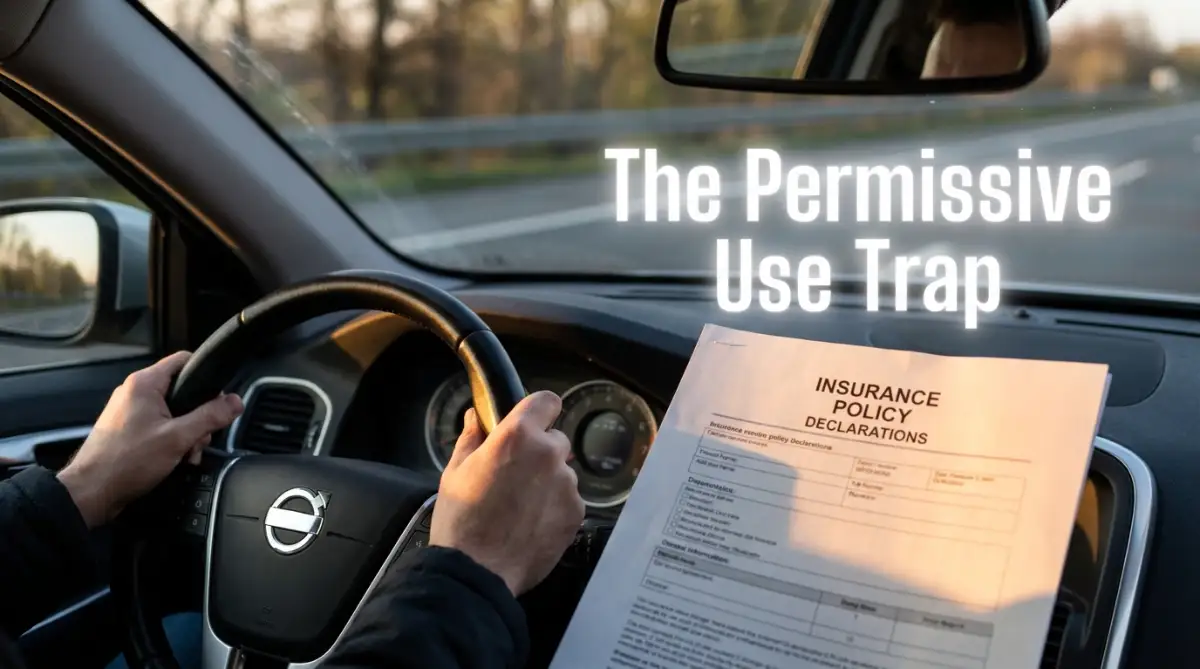
The "Permissive Use" Illusion
Most of us assume that our insurance follows our car, no matter who is behind the wheel. We gladly hand our keys to a friend who needs to run a quick errand.
We let our visiting cousin take the car to the grocery store. It feels like a completely harmless favor.
However, your provider might see this entirely differently. Many modern policies include very strict limits on what they call permissive use.
Some discount insurance companies will only cover drivers who are specifically listed by name on your policy. If an unlisted friend crashes your car, the company will legally deny the coverage.
Other companies might drastically reduce your coverage limits if an unlisted person is driving. For example, they might drop your expensive comprehensive coverage down to the bare state minimums.
Real-Life Scenario:
Think about John. He let his neighbor borrow his truck to pick up some heavy furniture. The neighbor caused a major accident on the highway.
Because John's policy had a "named driver only" restriction, his insurance paid absolutely nothing. John was sued personally for the damages.
How to Fix This Today:
Call your agent and ask one direct question. Say, "If a friend borrows my car occasionally, are they covered with my full policy limits?" If the answer is no, you need to upgrade your coverage immediately.
The Danger of Unreported Modifications
We all love making our cars feel a bit more personal. Last year, I dropped $1,200 on a custom Pioneer Apple CarPlay system and new alloy rims for my Toyota Tacoma. These modifications definitely made my daily commute better, but they also massively changed the car's actual cash value. If you do not formally report these specific aftermarket upgrades to your insurance provider, you are sitting on a ticking time bomb. Most standard policies only cover the exact factory parts that came with the car.
If your car gets stolen or totaled, the company will only write a check for the base model. All the hard-earned money you spent on upgrades will vanish.
Even worse, some major modifications can actually void your entire policy. If you add a high-performance engine part, the insurer might claim the car is now a "racing risk."
Expert Insight:
Never hide your vehicle upgrades. Insurance companies use detailed inspection reports after an accident. If they find unapproved performance modifications, they will classify it as a breach of contract.
Always keep the receipts for any aftermarket parts. Call your agent and ask to add a custom parts and equipment endorsement to your current policy. It usually costs very little but saves you thousands.
The Business Use Exemption Trap
With inflation squeezing our grocery budgets right now, having a side hustle feels basically mandatory for survival. I know so many people who turn on UberEats or DoorDash for a few hours after their 9-to-5 just to pay off their credit cards. It seems like a harmless way to make extra cash. But logging into those gig apps without telling your insurance company is a complete financial death trap. Every personal auto policy includes a strict exclusion for business and commercial use.
Myth vs Reality:
- The Myth: "My personal insurance will cover me as long as I do not have a passenger in the car yet."
- The Reality: The exact second you log into a delivery or rideshare app, your personal auto coverage shuts off completely.
If you get into a fender bender while holding a hot bag of food, your provider will deny the claim. They will argue that you were operating a commercial business without commercial insurance.
You cannot rely on the basic insurance provided by the gig apps either. Those corporate policies often have massive deductibles, sometimes reaching up to $2,500.
If you use your car to make money, you must tell your provider. You need a specific rideshare endorsement or a hybrid business use policy.
Leaving Household Members Off the Policy
This is one of the most common reasons claims get denied outright. Insurance companies calculate your monthly rate based on the risk of everyone living in your house.
When a teenager gets their driver's license, your rates usually go up significantly. To save money, some parents conveniently "forget" to add the new teen driver to the policy.
Sometimes, people move in with a new roommate and share cars, but they never update their insurance details. This strategy might save you a few dollars a month, but it is considered soft insurance fraud.
I made a huge mistake a few years ago by trying to save twenty dollars a month by not listing my younger brother on my policy when we lived together. When he backed my car into a mailbox, the insurance company investigated our living situation and almost canceled my entire policy on the spot. My best tip is to just be totally honest about who lives in your house and has access to your keys, because a tiny monthly saving is never worth a massive denied claim.
A Simple Comparison to Understand the Risk:
If someone lives at your address and has access to your car keys, the insurance company wants to know about them. If that unlisted resident crashes your car, the denial is almost guaranteed.
You have two safe choices. You either list them as a covered driver, or you list them as an excluded driver.
An excluded driver is someone who is explicitly banned from driving your car under the contract. Just remember, if an excluded driver takes the wheel in an emergency and crashes, you are still entirely on your own.
The Strict Timeline for Reporting Accidents
After a major accident, your brain is flooded with adrenaline and stress. You are worried about finding a rental car, checking on your family, and missing work.
Calling your insurance company sometimes gets pushed to the bottom of your priority list. You might think, "I will just call them next week when things settle down."
This innocent delay can easily destroy your chances of getting paid. Every auto policy has a clause regarding prompt notification of a loss.
Insurance companies need to investigate accidents quickly. They need to send adjusters to look at the damage before the weather ruins the evidence.
They need to interview witnesses before their memories fade away. If you wait too long to report the incident, you take away their ability to investigate properly.
They will use this delay against you. They will state that your delayed reporting prejudiced their investigation, giving them the legal right to deny the payout.
Do not try to handle small accidents under the table with the other driver. The other driver might promise to pay cash out of pocket today.
But a week later, they might stop answering your calls. By the time you finally involve your insurance company, it might be too late to file a valid claim.
Always report any incident within 24 hours, even if you are not entirely sure you will file a formal claim. It creates a paper trail and protects your legal rights.
Expert Strategies to Bulletproof Your Auto Insurance Coverage
You already know the basic tricks insurance companies use to avoid paying out. But simply knowing the traps is not enough to protect your hard-earned money.
We need to turn you from a regular customer into a highly educated policyholder. It is time to learn the advanced strategies that industry insiders use to guarantee their claims get approved.
The most important habit you can build is performing an annual policy audit. Do not just let your contract auto-renew without looking at the details.
Your life changes constantly, and your coverage needs to evolve with you. If you get a new job closer to home, your daily commute mileage drops significantly.
Reporting this lower mileage can actually reduce your premium while keeping you perfectly compliant. You always want your stated facts to match your daily reality.
Bridging the "Actual Cash Value" Gap
One of the biggest shocks drivers face is understanding how their car is valued after a total loss. Standard policies only pay out the actual cash value of your vehicle.
This means they calculate the original price and then subtract thousands of dollars for depreciation. If you bought a car for $30,000, they might only value it at $20,000 just a few months later.
If you still owe $28,000 on your auto loan, you are personally stuck paying that $8,000 difference. You are literally paying for a car you can no longer drive.
To fix this massive financial hole, you must ask your agent about Gap Insurance. This specific add-on covers the exact difference between what the car is worth and what you owe the bank.
If you want to understand how standard definitions protect consumers, you can read the official guidelines provided by the National Association of Insurance Commissioners (NAIC). They offer completely unbiased, state-level regulations on how car valuations should be handled.
Protecting Your Entire Financial Life
Your car insurance does not just protect your vehicle; it protects your entire net worth. If you cause a severe accident with multiple injuries, the medical bills can easily exceed your standard limits.
If your policy maxes out at $100,000, but the other driver's medical bills hit $300,000, they will sue you for the rest. They can legally come after your savings accounts, your investments, and even your future paychecks.
This is exactly why financially savvy people never rely solely on standard auto coverage. They invest in a lifesaver called a Personal Umbrella Policy. If a horrible multi-car pileup exhausts your standard limits, this umbrella policy kicks in, providing an extra $1 million in liability protection for less than the cost of your monthly Netflix subscription. It acts as a giant, stress-free safety net over your entire life. Before you panic and start Googling how to cash out your 401(k) to pay off an unexpected lawsuit, just look into getting umbrella coverage.
Pro-Level Q&A:
- Question: Should I drop comprehensive coverage to save a few bucks on an older car?
- Answer: Only if you have enough cash sitting in the bank to replace the car tomorrow. Otherwise, keep the coverage active.
Do not assume that your basic benefits are enough to keep your family safe from a worst-case scenario. Much like relying purely on employer-provided protection, assuming you are fully covered without reading the fine print is extremely risky.

The Catastrophic Missteps That Cost Drivers Everything
Even with the best policy in the world, human error can destroy your coverage in seconds. People make deeply emotional decisions right after a crash that completely ruin their legal standing.
Let us talk about the absolute worst mistakes you can make as a policyholder. These are the exact actions that give the insurance company the green light to deny your claim instantly.
The Handshake Deal Trap
This happens every single day in grocery store parking lots and intersections. You get rear-ended at a red light, and the teenager who hit you jumps out looking terrified. They are crying, apologizing profusely, and begging you not to involve State Farm or call the cops because their rates are already too high. They promise to Venmo you cash directly for the bumper repair. You feel bad for them, so you shake hands and drive away without filing an official police report. I am telling you from painful personal experience—this is the absolute biggest mistake you will ever make.
A few days later, your neck starts hurting terribly. You realize the bumper damage is actually hiding structural damage underneath the car.
When you finally call that friendly driver, their phone number is completely disconnected. Now, you have no police report, no proof of the accident, and a broken car.
Because you failed to report the accident promptly, your own insurance company will likely deny your claim. Never let guilt or empathy stop you from protecting yourself legally. Always call the police to document the scene objectively.
Committing "Soft Fraud" by Accident
Many drivers think they are being incredibly clever by playing games with their home address. They know that insurance rates are much higher in busy, urban cities due to traffic and crime.
To save money, they list their parents' quiet suburban home as the primary address on the policy. They think this harmless little white lie is a smart financial hack.
In the insurance industry, this is known as rate evasion, and it is treated incredibly seriously. It is a form of legal misrepresentation.
If your car is stolen from your apartment in the city, the investigator will ask hard questions. They will check your utility bills and your daily commute patterns.
When they realize the car was never kept at the suburban address, they will cancel your policy immediately. You will get zero dollars for your stolen car.
To see how aggressively these simple lies are investigated, you can review public data from the National Insurance Crime Bureau (NICB). They actively track and report these exact types of rate evasion tactics across the country.
Failing to Update Life Changes
Your insurance contract is based on a specific snapshot of your life on the day you bought it. But your life does not stay frozen in place.
Maybe you got divorced, moved to a new state, or changed your name. If you do not update your provider, your documents become legally invalid.
Imagine getting into a wreck and having a check delayed for months because your legal name no longer matches the policy. It is a completely avoidable nightmare.
Quick Do's and Don'ts for Policyholders:
- Do: Take a video of your car's condition every six months.
- Do: Call your agent the moment your teenager gets their learner's permit.
- Don't: Lie about how many miles you drive each year.
- Don't: Let a friend drive your car if you are unsure about your permissive use rules.
Ignoring these simple rules can plunge you into deep financial trouble. Instead of getting a quick repair, you might find yourself forced to seek fast unsecured bank loans just to buy a replacement vehicle out of pocket.
Do not let laziness or a desire to save ten dollars a month put your entire family at risk. A denied claim is one of those hidden legal traps that can destroy your financial standing before you even realize what happened.
Your Action Plan for Total Driving Confidence
I know dealing with insurance jargon is exhausting, and waiting on hold listening to terrible elevator music is the last thing you want to do on a weekend. But you no longer have to live in constant fear of that dreaded claim denial letter showing up in your mailbox. You now understand the sneaky loopholes around permissive use and why hiding your DoorDash side hustle will ruin you financially.You know the severe dangers of hiding gig work or unlisted drivers from your provider.
More importantly, you understand the extreme risk of rate evasion and handshake deals at the accident scene.
You are entirely in the driver's seat when it comes to your financial protection. The power is entirely in your hands, but you have to take action today.
Your 15-Minute Policy Audit Plan
I want you to take just fifteen minutes this weekend to review your own coverage. Grab a cup of coffee, sit down at your computer, and open your Declarations Page.
Look at every single name listed on that document. Ensure your garaging address is one hundred percent accurate.
Check your liability limits and ask yourself honestly if they would cover a major disaster. If you see anything confusing or incorrect, pick up the phone and call your agent on Monday morning.
Ask them direct, specific questions about your daily driving habits. It is much better to have an awkward five-minute phone call today than a devastating financial loss tomorrow.
You work far too hard for your money to let it disappear due to a technicality hidden on page forty of a contract. Take control of your policy, drive with absolute confidence, and keep your family protected on every single journey.
Looking back at my own insurance nightmare, I realize now that spending just ten minutes reading my policy could have saved my bank account. You do not have to feel powerless against these big insurance companies anymore. Take a deep breath, grab your policy papers today, and make those phone calls to your agent so you can finally drive with total peace of mind.
Disclaimer: The information provided in this article is for educational and informational purposes only and does not constitute formal legal or financial advice. Auto insurance laws and policy terms vary significantly by state and provider. Always consult directly with a licensed insurance agent or legal professional regarding your specific contract details before making any coverage decisions.